The short verdict
Companies pay for market research to learn what customers care about. They hear it every day - nobody writes it down, because a salesperson answers the question and moves on.
The AI agent has to write it down. When it cannot back a claim it must say so, otherwise the reply would not pass. That note has been saved against every draft since the agent started running. The report only reads it back.
The result is a list ranked by how often a question came up, with the companies it came from. Plus a button that turns the question into material, so the agent does not stop there next time.
Why this beats a survey
A survey asks the people who fill it in. This list comes from people who answered your outreach themselves - which is to say, the ones that matter.
And it does not ask what they think interests them. It shows what they asked at the moment they were considering a purchase. Different question, different answer.
Above all it costs nothing and requires no extra work. It accumulates as a by-product of a check that has to be there anyway.
How a question gets into the report and out again
The agent has no material → it records that on the draft → the report groups and ranks → one save turns it into material or a fact.
The note is made on every draft
This is not a feature somebody can forget to switch on. When the agent cannot back a claim it flags the missing material and recommends handing over - otherwise the reply would not pass.
Similar questions merge
“How much is the installation?” and “Installation price?” are the same question. They group by meaning rather than exact wording, so the list is not twenty variants of one thing.
Ranked by how often it came up
The most frequent sits at the top. Each entry shows the companies it came from and when it was last asked. The window can be thirty days, ninety, or a year.
Alongside it, what stopped the replies
Besides missing material, the reasons the agent handed over are counted too - pricing questions, contractual topics, complaints. The difference between “we have no material” and “a robot should never handle this” is visible at a glance.
The question becomes the answer
Every entry has a button that opens a field right there. A question about a number is saved as a fact with an expiry, anything else as text material. The gap closes where it is visible, not in a note for later.
What to do with it
Fill the missing answers. Fastest return: the first five entries usually cover most of what the agent stops on.
Rewrite the argument. When the same question keeps returning after you added material, it is not a gap in knowledge - it is a gap in the offer, or in how it is described.
Take it to a meeting. A list of questions your market actually asks is better preparation than any deck.
Watch whether it shrinks. A shrinking list means the base is maturing. A growing one means you opened a segment you cannot yet describe.
What tends to be on such a list
“How much is it?” as the top entry on an account that has not stored a price list yet.
A technical parameter that lives in your catalogue but not in the agent's material - an easy fix.
A question about integrating with a system you did not know your customers used.
A lead-time question for a country you have never shipped to. That is no longer a knowledge gap, it is a commercial finding.
A repeated question about something you do have on file - a signal that it is written in a way the agent cannot find.
Why it deserves attention
Zero cost
01A by-product, not a project
It is not collected for a report; it is collected for a check that must exist anyway.
History from the start
02The first open is not empty
The data has accumulated since the agent started running, not since you opened the screen.
A closed loop
03Question to material in one save
The gap closes where it is visible, not in a note for next time.
What to take from this
An agent that admits it does not know something is uncomfortable only until you notice it is collecting the most valuable thing you can have about your own market.
Open the report after a month of running. The first five entries will tell you more about your offer than a quarterly review.
Keep reading
These related pages connect the strategy, compliance and real workflow behind Leeeds.
AI sales agent
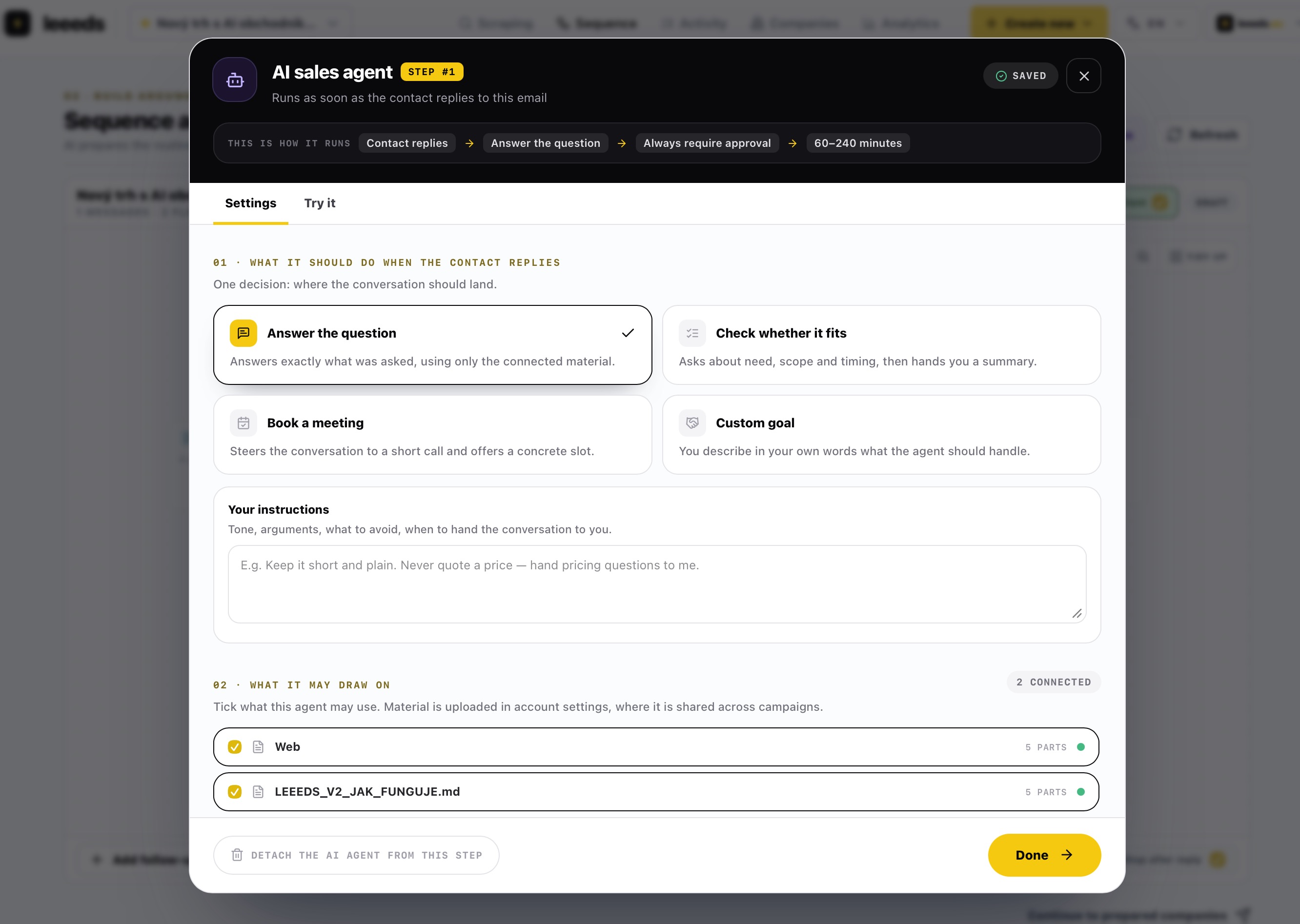
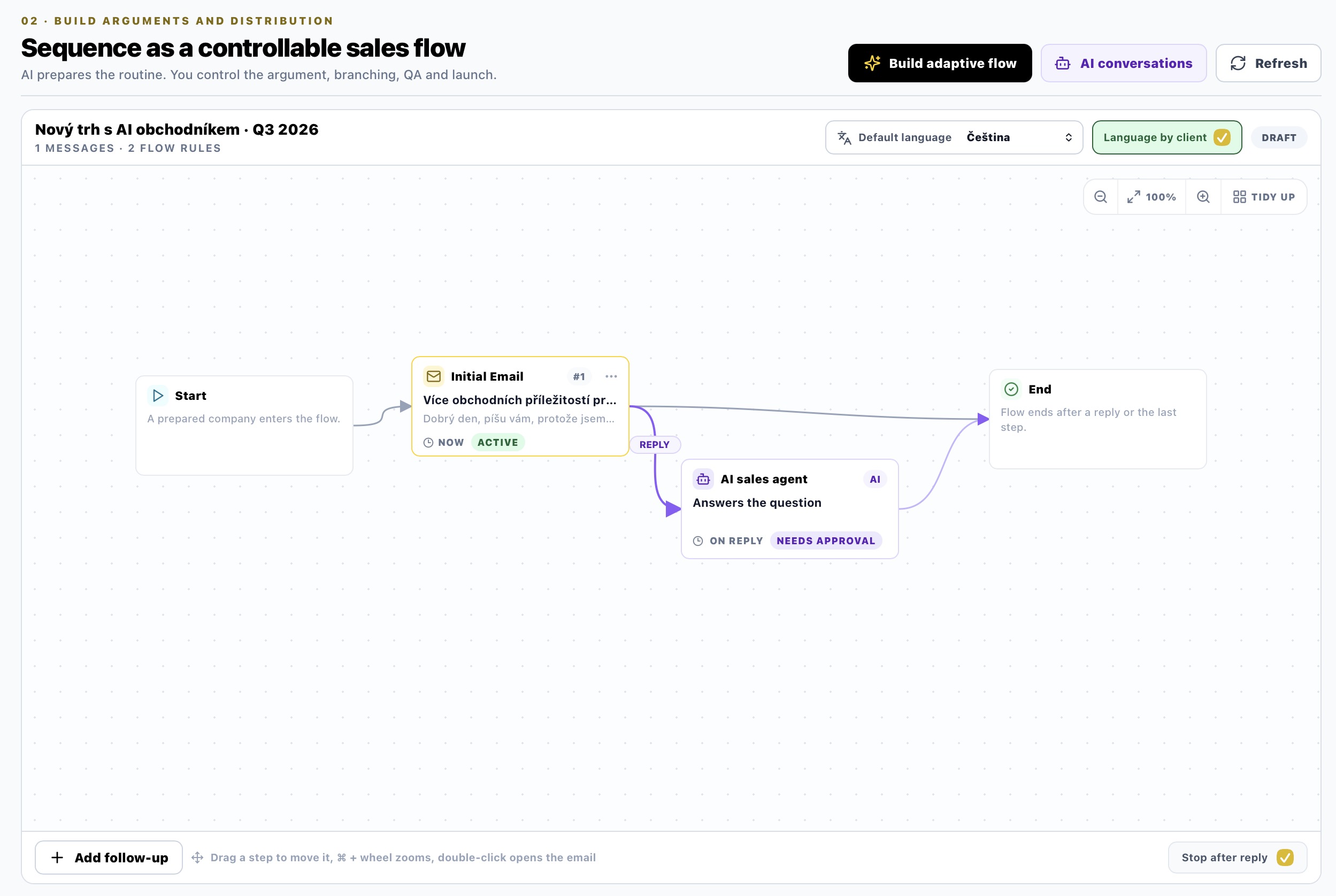
How the AI sales agent works
The Leeeds AI sales agent sits on one sequence step, fires only when a contact replies, answers from your own material and waits for your approval. With screenshots.
Read next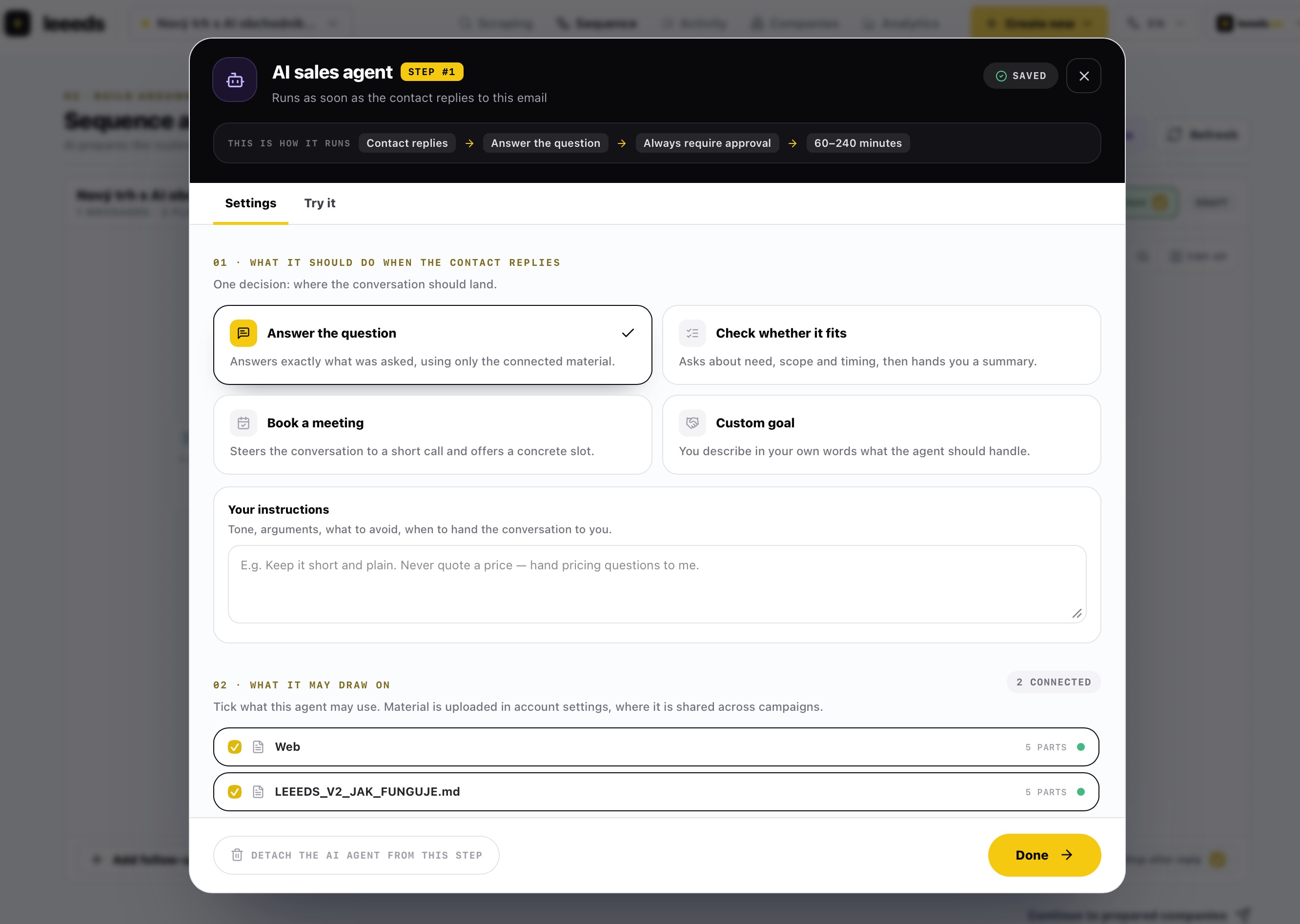
AI sales agent
How the agent handles numbers
Most AI tools either invent a price or dodge the question. Leeeds stores it as a fact with an expiry date: the agent repeats it exactly, shows the source, and stops saying it the day it expires.
Read nextAI sales agent
How a meeting happens
Agreeing a meeting by email takes four extra messages and two days. Leeeds offers three genuinely free times, holds them, and creates the event with an invitation once confirmed.
Read nextAI sales agent
Agent for inbound questions
On your site and in info@ sit people who are already interested. Leeeds answers them from the same material and facts as in a campaign - and invents nothing it cannot back.
Read nextWant to know what you get asked most?
The agent has been recording it since day one. All that is left is to read it.
I want the AI agentLeeeds · acquisition automation with an AI sales agent