
The visitor did not leave because they had no interest
Companies invest in ads, SEO, content and outbound to bring relevant people to their website. And that is exactly where acquisition tends to stall. The visitor opens a few pages, goes back to pricing or references, and leaves without a contact.
Often they were only missing the answer to one specific question. Is the service a fit for a smaller company? Roughly what does it cost? Does it work with our current system? Can you deliver by our deadline? Have you worked in our industry?
A contact form is too big a step at that moment. The person does not want a sales call yet, they want to verify one thing. That gap is exactly where an AI chat on the website earns its place.
The difference between a visitor and a lead can be a single question
An industrial chemicals supplier brings a buyer from a manufacturing company to its site. The buyer lands on a product page and needs to know whether it suits their application. They could look for a datasheet, compare parameters or email a rep. Instead they ask in the chat.
If the chat has the matching information in its knowledge base, it can explain what matters for that application and ask back about temperature, joint stress or the environment the part will live in. This is no longer an ordinary product page visit: the company knows that a specific person is solving a specific use of a specific product.
When the visitor adds that this means several thousand units a month and they are replacing their current solution, the chat can naturally offer to pass the question to a specialist. Not as "leave your email before we tell you anything", but after the answer has actually been given. The contact stops being a precondition for the conversation and becomes its continuation.
From the first question to a handed-over contact
The chat is not there to interrogate everyone who opens the site. It answers, recognises genuine interest and brings a human in at the right moment.
The visitor asks a normal question
They do not need to know which page holds the information, work through ten menu items or decide which form to fill in. They write the question the way they hold it in their head.
The answer comes from your knowledge base
The chat works with your products, services, way of working, technical parameters and pricing rules. Not with a generic lecture about the industry that the visitor can read anywhere.
What is not in the material is not invented
A correctly configured chat says openly that it does not have the information and offers to pass the question to a person. On a public website an unsupported claim does more damage than an admitted gap.
The conversation reveals real interest
The first question can be curiosity. A third follow-up about multiple sites, an implementation deadline or production volume describes a concrete situation somebody is dealing with.
Sales receives the contact and the context
Instead of an anonymous "I would like more information", the rep sees the whole conversation: what the customer is solving, what they care about and where the decision sits. The first call does not start from zero.
What it looks like in practice
The same principle works for software, for services and as the continuation of an outbound campaign. Only the questions change.
SaaS and software
The question that reveals real interest
A visitor is looking at a warehouse management system and asks whether it handles multiple sites. Then whether each branch can hold its own stock. Then that management needs to see all branches together. The first question was simple; by the third it is clear this is not curiosity.
Services and projects
A signal worth more than a page view
A commercial solar installer gets asked whether it makes sense at roughly 120 MWh of annual consumption. The chat explains how such an assessment works and asks about the building type, the consumption profile and the available roof area. It does not replace an energy specialist, it recognises when to involve one.
Outbound campaigns
The campaign does not end with a click
The email recipient opens the landing page because the offer caught their attention, but is not ready to reply or book a meeting. They just want to know whether it suits a company of about fifty employees. Answer that immediately and the campaign turns into a conversation.
Feedback loop
What the company learns from conversations
A repeated question about whether the service also fits smaller companies means the target audience is not explained well on the site. Constant pricing questions despite a published price list suggest the list is hard to read. Analytics shows two minutes on a page; the conversation shows what the person needed during them.
The chat does not need to know everything. It needs to know your company.
The most important part of the solution is not the AI model itself, it is the context the company supplies. The knowledge base holds product and service information, the most frequent customer questions, the way you work, technical parameters, basic pricing information and the rules by which the company handles a particular type of enquiry.
The difference shows immediately. When a software company's prospect writes that they run a specific accounting system and want to know whether you can integrate with it, they do not need a general explanation of what accounting software is. They need an answer about the product they are looking at. A dedicated knowledge base turns the AI from a universal assistant into a tool that understands one specific business.
Equally important is what happens when the answer is not in the knowledge base. The chat has no reason to improvise: it admits the information is missing and offers to pass the question to a person. That brake is what separates a usable sales tool from a chatbot nobody trusts.
Compared with a form, a conversation also carries less friction. A form asks for name, email, phone, company and a description of the enquiry all at once, which is a large commitment for somebody still checking whether the service fits. In a chat the person asks a question, gets a useful answer, and only gradually does it become clear whether this is an information request or a sales opportunity.
The questions business actually starts from
"Is this adhesive suitable for bonding aluminium to coated sheet metal?"
"We run our own accounting system. Can you integrate with it?"
"Does solar make sense for us at roughly 120 MWh of annual consumption?"
"Is this suitable for a company with around fifty employees?"
What the AI chat adds to your sales
Context
01A lead with a story
The rep sees what the customer was solving, what they asked and where the decision sits. Not just an email and the line "I would like more information".
Availability
02An answer at six in the morning
The AI is online and the team joins the started conversation later. The visitor does not have to wait for office hours to learn one basic fact.
Leverage
03The traffic you already have
Instead of more campaigns you make better use of the people who visit today and today leave without any interaction.
The biggest gain may not be more visits
A well-deployed AI chat is not there to replace the human sales team. It removes the part of the work that does not need a person and gets the rep earlier to the situations where their work does matter. The difference is that they no longer start with a completely unknown lead, but with somebody who has already described part of their situation.
Most company websites still work mainly as a library of information the visitor has to search themselves. With a chat built on a good knowledge base, a passive presentation becomes an active part of the sales process. Not every visitor turns into a lead, and none should be forced to. The point is to catch the ones who already have interest but would otherwise leave.
When a company wants more customers, the first reaction is usually the same: bring more people to the website. But traffic alone does not create business. If relevant people already visit and most of them leave without any interaction, there is a cheaper path - make better use of the traffic you already have. Between an anonymous visitor and a new customer there is sometimes not another campaign, but one unanswered question.
Frequently asked questions about AI chat on a website
Short answers to what companies considering a website chat ask us.
What is an AI chat on a website good for?
An AI chat answers the visitor at the moment they have a specific question instead of waiting for a form. It answers from that company's own information, and when the conversation shows commercial potential it collects the contact and passes it to the team together with the context.
How does it tell a real lead from a browser?
From how the conversation develops. A single question is informational, but follow-ups about the number of sites, production volume, deadlines or integration with an existing system describe a concrete situation. Only then does offering a handover to sales make sense.
What happens when the chat does not know the answer?
A correctly configured chat does not improvise. It says openly that the information is not available and offers to pass the question to a person on the team. On a public website an unsupported answer causes more damage than an admitted gap.
Is a conversation better than a contact form?
It carries less friction. A form asks for name, email, phone and a description of the enquiry before the visitor even knows whether the service fits. In a chat a question is enough, and the contact is only discussed once the person has received a useful answer.
Will an AI chat replace a salesperson?
No. It answers repeating questions, explains the basics of the service and finds out what the customer is looking for. As soon as a concrete solution has to be proposed or negotiated, a human takes over, but no longer starting from an unknown lead.
Does an AI chat work outside business hours?
Yes. A visitor can write in the evening, at the weekend or early in the morning and gets an answer immediately. For more complex requests the chat gathers the context and the contact so the team can follow up later.
Keep reading
These related pages connect the strategy, compliance and real workflow behind Leeeds.
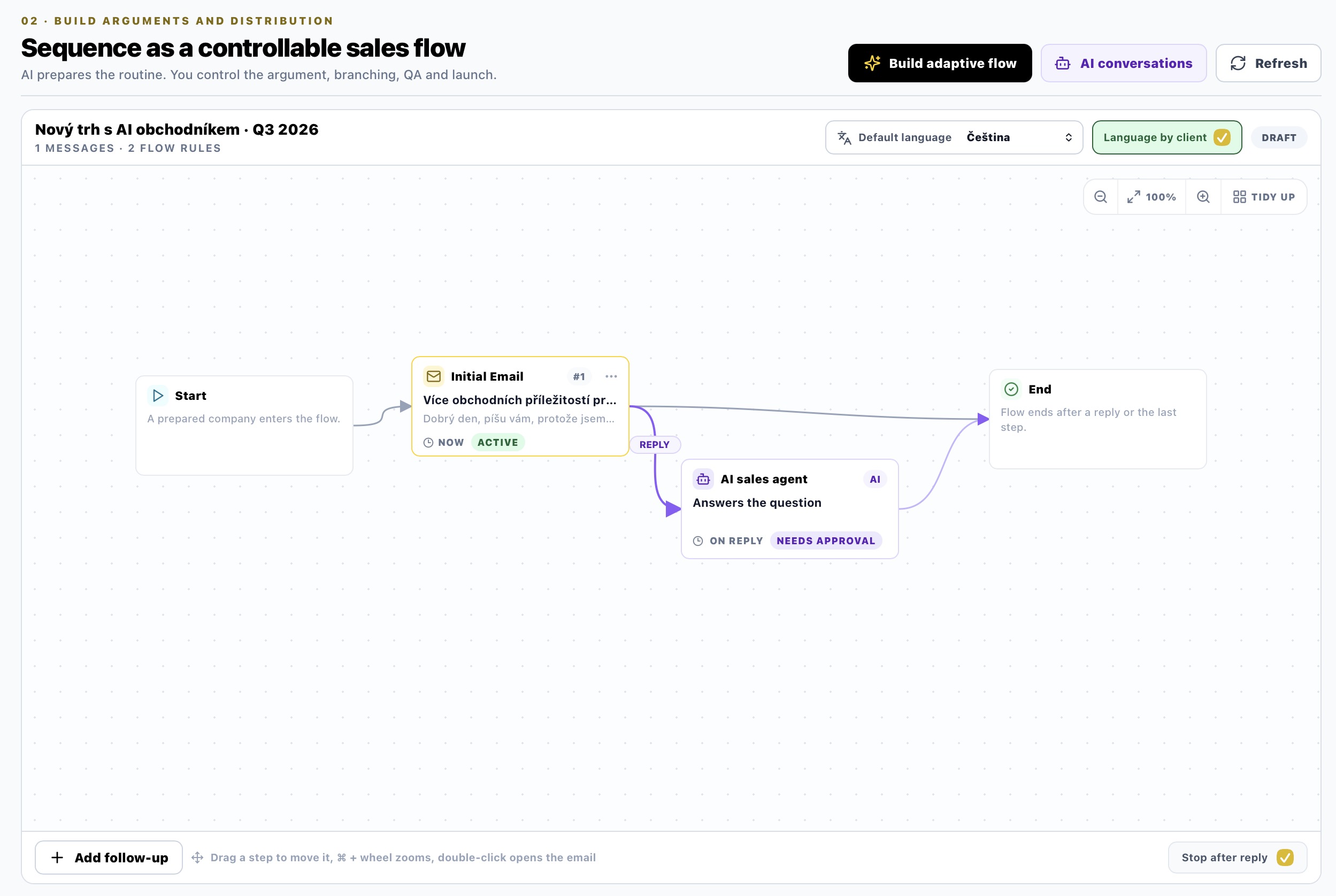
AI sales agent
How the AI sales agent works
The Leeeds AI sales agent sits on one sequence step, fires only when a contact replies, answers from your own material and waits for your approval. With screenshots.
Read next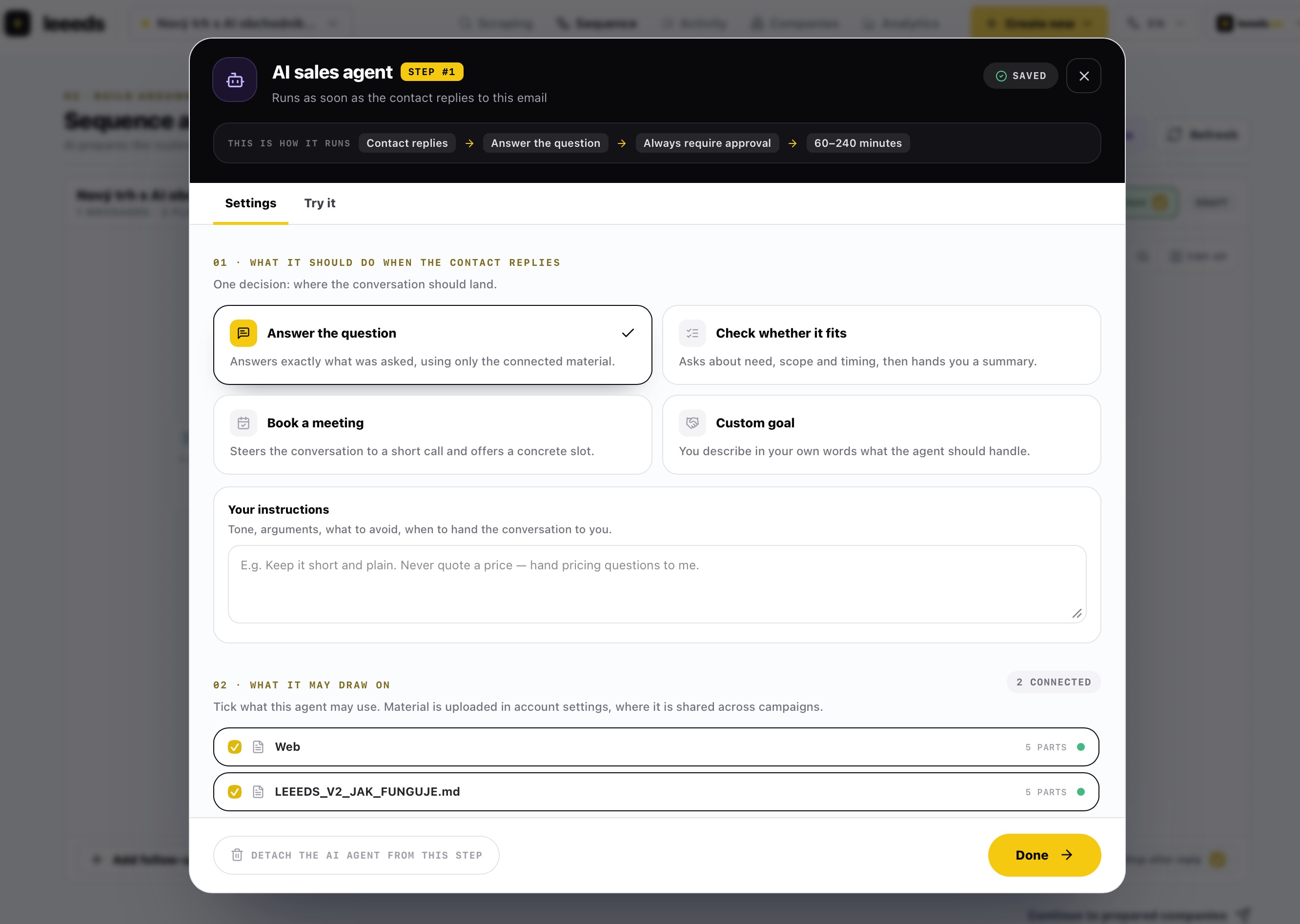
AI sales agent
How the agent handles numbers
Most AI tools either invent a price or dodge the question. Leeeds stores it as a fact with an expiry date: the agent repeats it exactly, shows the source, and stops saying it the day it expires.
Read nextAI sales agent
How a meeting happens
Agreeing a meeting by email takes four extra messages and two days. Leeeds offers three genuinely free times, holds them, and creates the event with an invitation once confirmed.
Read nextAI sales agent
What people ask you
Leeeds records what was missing on every draft. That becomes a ranked list of the questions your market actually asks - and one click turns a question into material.
Read nextFind out what your visitors are really asking
We will go through what the chat has to be able to answer, what belongs in the knowledge base and at which moment it should offer a handover to sales.
Get AI chat on my siteThis article describes how Leeeds AI Chat works with a company's own knowledge base. What is not in the material is not invented - the agent offers to pass the question to a person instead.