The short verdict
A campaign approaches people who do not know you. Your website and enquiry mailbox are the opposite: they came themselves and they are waiting for an answer - often until morning, or until Monday.
Leeeds sends the same agent to both. Same material, same stated numbers, same rule that an unsupported claim never leaves the building. Only the channel changes, and how fast that person needs an answer.
Why a public channel is harder than email
Email has time. A draft waits for approval and goes out with a human delay. On a website somebody is watching a cursor, and every extra second is a reason to leave.
It is also public. An invented price in an email is seen by one person; on a website anyone sees it and it survives in a screenshot. So an answer carrying an unsupported claim is never shown to the visitor - they get the admission and a request for contact instead.
And an enquiry mailbox also receives invoices, CVs and complaints. An automatic reply to that post is worse than none, so there the agent only ever drafts.
What an answer on the website looks like
A visitor asks → material and facts are searched → the answer is checked → it is shown, or handed to a human.
It answers only where it may
The widget runs on the same public key as website measurement and answers only on the domains you allowed. An unknown key, a paused site and a foreign domain all get one and the same response, so it cannot be used to discover which keys exist.
It searches what the account has
All enabled account material and valid facts are searched. The budget is tighter than for email - the visitor is waiting now, and an answer that arrives after they leave is worth nothing.
The wait is visible
The answer cannot be streamed: it is shown only once the whole of it has been checked against the sources, and half a sentence cannot be checked. So instead of an empty box, the visitor sees that work is happening.
Unsupported is never shown
If an answer carries a claim with nothing behind it, the visitor never sees it. They get the admission that we will pass it to the team, and a request for an email. The field switches to email input, so the expectation is obvious.
In the mailbox, a draft only
Post that belongs to no campaign becomes an inbound conversation and the agent drafts an answer for it. It never sends. The writer does not become a company in a campaign, so statistics are not filled with people nobody approached.
What you configure
The website. One `<script>` tag you copy in Account → Connections. The widget lives in its own isolated space, so its CSS and your site's cannot reshape each other, and the session key lives in the browser tab rather than a tracking cookie.
The enquiry mailbox. You tick a mailbox Leeeds already reads. Only post belonging to no campaign is processed; a contact's reply to a campaign continues down its usual path and out-of-office auto-replies are skipped.
Credits. A contact from your own website costs nothing - you brought them yourself and they usually leave no contact at all. A processed mailbox enquiry costs one credit, because it produces a new contact that was not in the database. With an empty wallet nothing is drafted and the message is left untouched.
The overview. Conversations from both channels sit on one screen, with citations against the answers and a label for website or mailbox.
How it plays out in practice
A visitor asks about a parameter you have on file: they get the exact answer, and in the portal you see the source next to it.
They ask about price and your price list is valid: it is stated exactly. Without one, the agent says it will pass the question on and asks for contact details.
They write a complaint: the agent invents nothing, flags the conversation and hands it over - exactly as in email.
An enquiry lands in info@: the agent drafts an answer, the conversation waits for a human, and you send it from your own mailbox.
An invoice lands in info@: nothing is sent. You see the conversation with its draft and decide yourself.
Why this makes sense
A warmer audience
01They came themselves
Nobody on your site or in your enquiry mailbox needs convincing that they are interested.
One base
02No second truth
What holds in email holds on the website. No channel can start saying something different.
Public, safely
03Unsupported is not shown
A wrong answer on a public site is worse than a slow one.
What to take from this
Most companies have a form on their site that somebody reads tomorrow. The difference between that and an agent is not the speed of the reply - it is that the agent answers only what is backed, and sends the rest to you.
Start with the website. It switches on with one line and costs nothing. Add the enquiry mailbox when you want to.
Keep reading
These related pages connect the strategy, compliance and real workflow behind Leeeds.
AI sales agent
How the AI sales agent works
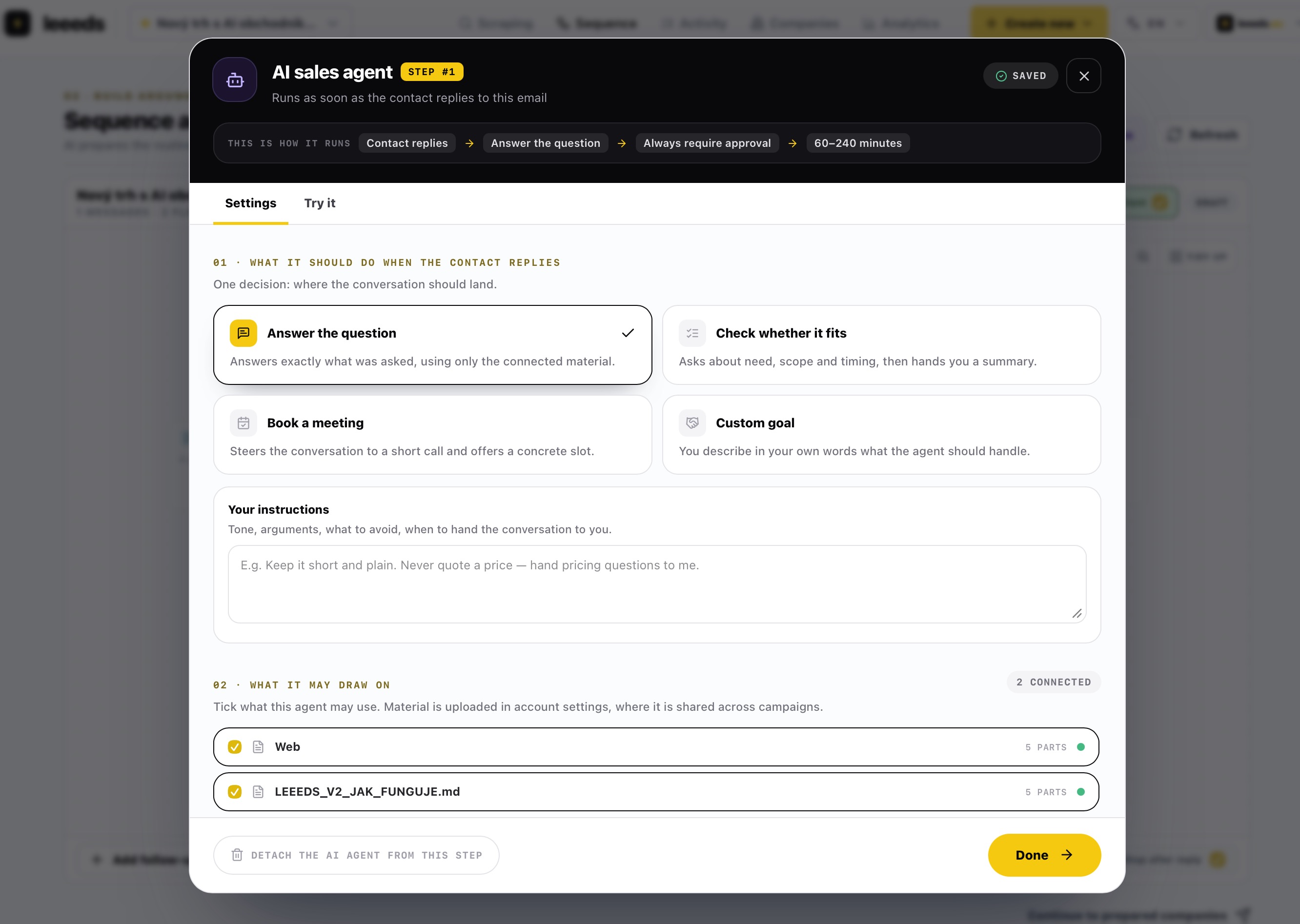
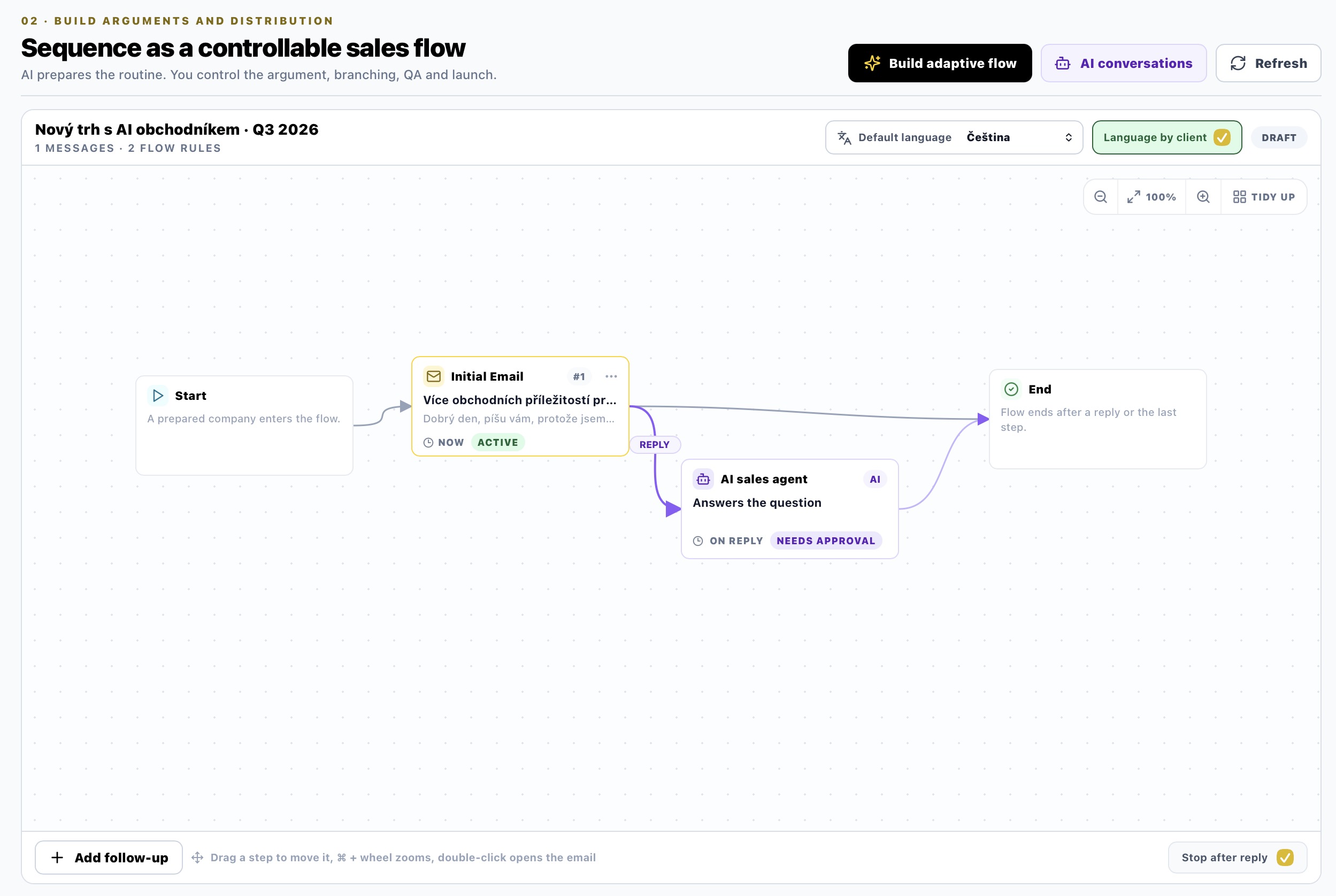
The Leeeds AI sales agent sits on one sequence step, fires only when a contact replies, answers from your own material and waits for your approval. With screenshots.
Read next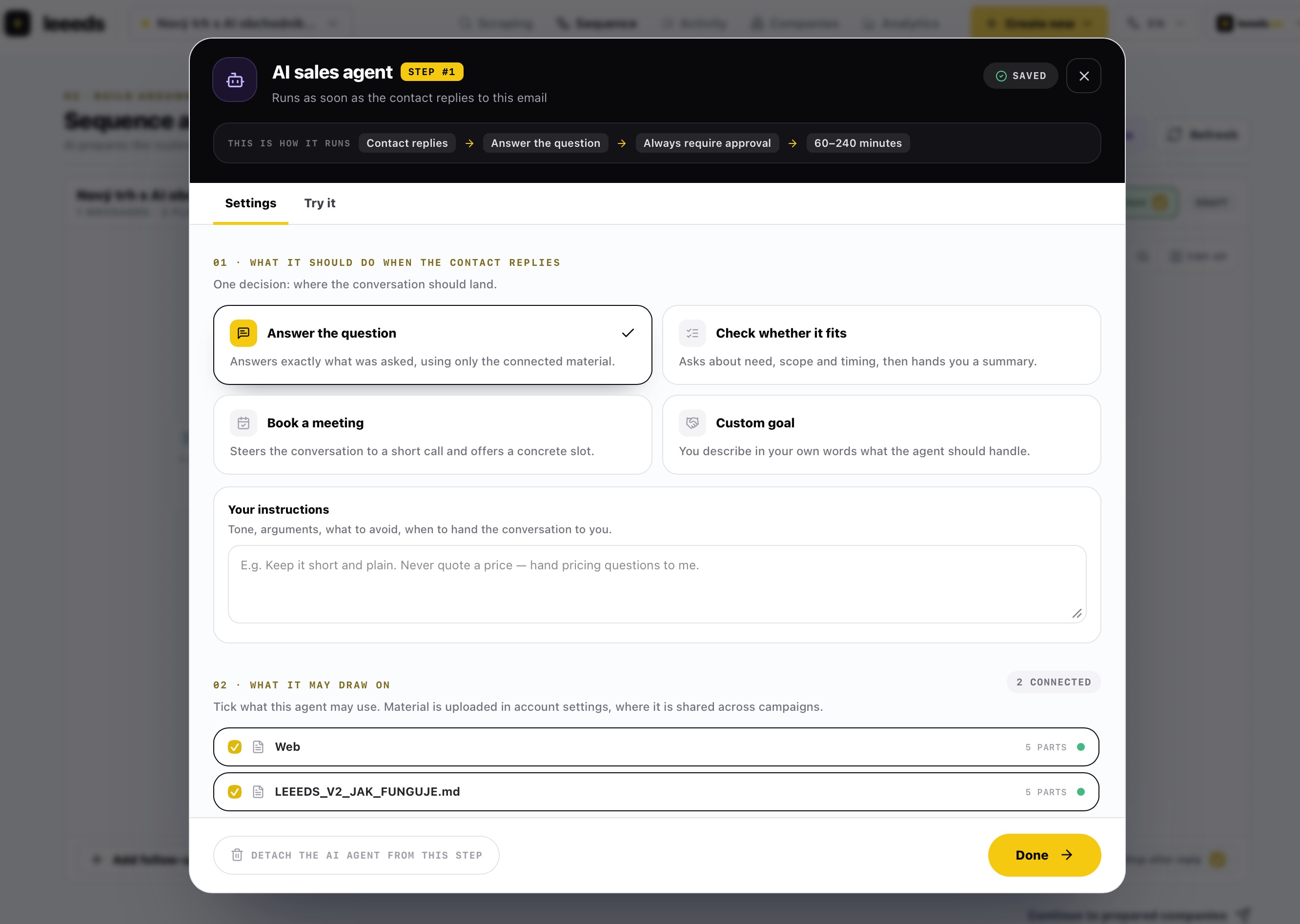
AI sales agent
How the agent handles numbers
Most AI tools either invent a price or dodge the question. Leeeds stores it as a fact with an expiry date: the agent repeats it exactly, shows the source, and stops saying it the day it expires.
Read nextAI sales agent
How a meeting happens
Agreeing a meeting by email takes four extra messages and two days. Leeeds offers three genuinely free times, holds them, and creates the event with an invitation once confirmed.
Read nextAI sales agent
What people ask you
Leeeds records what was missing on every draft. That becomes a ranked list of the questions your market actually asks - and one click turns a question into material.
Read nextWant to answer where the interest already is?
One line on your site, and the same agent you know from campaigns.
I want the AI agentLeeeds · acquisition automation with an AI sales agent